The question sounds like a trick, and the fun of it is that nothing about it is:
Your phone is in airplane mode. You open Google Authenticator and it generates a valid 6-digit code. No internet. No Wi-Fi. No signal. You enter it on a website, and the server instantly knows whether it's correct. How does the server know the code your phone generated?
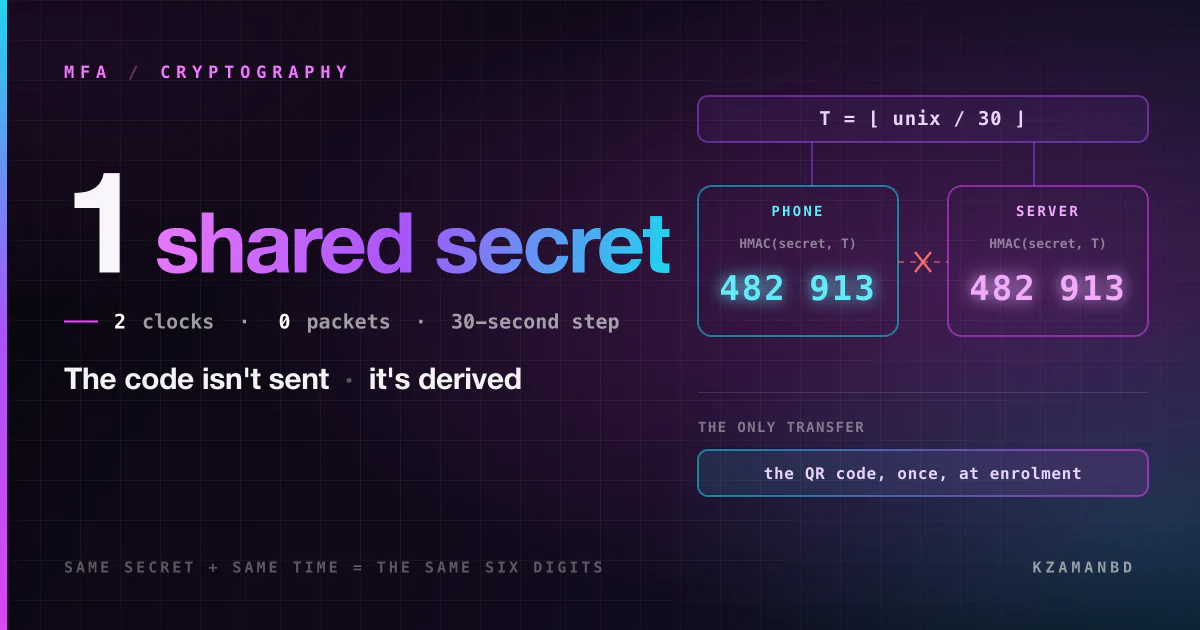
The answer in one sentence: the code was never transmitted, so it never needed a network — it was derived, independently, on both sides, from two things they already share. Those two things are a secret (exchanged exactly once, when you scanned the QR code) and the current time.
That's it. The phone is not communicating with anything. It is evaluating a pure function. The server evaluates the same function with the same inputs and gets the same answer. The mechanism has a name and a spec: TOTP, RFC 6238 — Time-based One-Time Password.1
Step 0: the only moment data ever moves
Every confusion about TOTP dissolves once you separate the two phases. They happen years apart and only one of them involves a network.
| Phase | When | What crosses the wire |
|---|---|---|
| Enrolment | Once, at setup | The shared secret, inside the QR code |
| Authentication | Every login | Only the 6 digits you type, from your fingers to the site |
The QR code is not a picture of your account. It is a URI carrying a random secret the server just generated:
otpauth://totp/Example:[email protected]
  ?secret=JBSWY3DPEHPK3PXP      # base32 of the raw secret, 160 bits recommended
  &issuer=Example
  &algorithm=SHA1               # RFC default
  &digits=6
  &period=30
Your phone stores that secret in its keychain and never asks for it again. The server stores its copy next to your user record. From that moment on, both parties hold the same secret and have no further need to talk.
Note carefully what the phone does not have: your password, an account session, or any connection to the site you are logging into. Google Authenticator has no idea what happens to the digits it shows you.
title: Enrolment vs authentication
packets: on

scenario "Enrolment (once, needs a network)"
> The only time the secret exists on the wire. After this, the two sides are independent.
Server [generates 160-bit secret] --> Screen (otpauth:// QR code) {secure}
Screen --> Phone (scan, store in keychain) {secure}
Phone --> Server (first code, to prove the scan worked) {secure}
Server --> DB (store secret encrypted, mark MFA enabled) {allowed}
> Both sides now hold the same secret. Nothing else is ever exchanged.

scenario "Authentication (every login, needs nothing)"
> Two independent computations of the same pure function. Airplane mode is irrelevant.
Phone [offline] --> Phone (HMAC(secret, T) -> 482913) {secure}
User --> Browser (types 482913) {neutral}
Browser --> Server (POST /mfa 482913) {neutral}
Server [same secret, own clock] --> Server (HMAC(secret, T) -> 482913) {secure}
Server --> User (match: session granted) {allowed}
> The phone never talked to the server. It did not have to.
Step 1: the algorithm, exactly
TOTP is HOTP (RFC 4226, a counter-based one-time password) with the counter replaced by a number derived from the clock. Four steps.
1. Turn the time into a counter. Both sides compute the same integer, because both use Unix time — a shared, absolute reference:
T = floor((unix_seconds - T0) / X) T0 = 0, X = 30 secondsEvery 30 seconds T increments, on every device on Earth, simultaneously. This is the
part that makes the whole scheme work: no coordination is needed because both sides
already agreed to use the same clock.
2. HMAC the counter with the secret. T is encoded as an 8-byte big-endian integer:
mac = HMAC-SHA1(secret, T_as_8_bytes) // 20 bytes3. Dynamic truncation — squeeze 20 bytes into a 31-bit number, using the last nibble of the MAC to choose where to read from:
offset = mac[19] & 0x0f                  // 0–15
code   = ((mac[offset]   & 0x7f) << 24)
       | ((mac[offset+1] & 0xff) << 16)
       | ((mac[offset+2] & 0xff) <<  8)
       |  (mac[offset+3] & 0xff)
That & 0x7f on the first byte clears the top bit, so the result is unambiguously
positive in languages with signed 32-bit integers — a spec detail that exists purely to
stop implementations disagreeing.
4. Modulo down to six digits, zero-padded:
otp = code % 1_000_000 // 000000–999999Written out, the whole thing is about fifteen lines:
import { createHmac } from 'node:crypto';

export function totp(secret: Buffer, at = Date.now(), step = 30, digits = 6): string {
    const counter = Math.floor(at / 1000 / step);

    // The counter as a big-endian 64-bit integer — the input both sides agree on.
    const buf = Buffer.alloc(8);
    buf.writeBigUInt64BE(BigInt(counter));

    const mac = createHmac('sha1', secret).update(buf).digest();

    // Dynamic truncation: the low nibble of the last byte picks the 4-byte window.
    const offset = mac[mac.length - 1]! & 0x0f;
    const binary =
        ((mac[offset]! & 0x7f) << 24) |
        ((mac[offset + 1]! & 0xff) << 16) |
        ((mac[offset + 2]! & 0xff) << 8) |
        (mac[offset + 3]! & 0xff);

    return String(binary % 10 ** digits).padStart(digits, '0');
}
The server runs that exact function. Same secret, same T, same six digits. There is
no channel because there is nothing to send.
flowchart LR
    S["Shared secret<br/>(from the QR, once)"] --> H["HMAC-SHA1"]
    C["Unix time ÷ 30<br/>(both clocks agree)"] --> H
    H --> D["Dynamic truncation<br/>31-bit number"]
    D --> M["mod 10⁶"]
    M --> O["482913"]
Note
HMAC-SHA1 here is not a security weakness. SHA-1's broken property is collision
resistance, which HMAC does not rely on; HMAC-SHA1 remains sound. RFC 6238 permits
SHA-256 and SHA-512, but many authenticator apps historically ignored the algorithm,
digits and period parameters and assumed SHA1/6/30 — so changing them is an
interoperability decision more than a security one.
Step 2: the clocks are never exactly right
Two independent clocks will not agree to the millisecond, and a user takes several seconds to read six digits and type them. So verification checks a small window of time steps, not just the current one:
export function verify(secret: Buffer, submitted: string, window = 1): number | null {
    const now = Date.now();
    for (let drift = -window; drift <= window; drift++) {
        const candidate = totp(secret, now + drift * 30_000);
        // Constant-time compare: never leak how much of the code matched.
        if (timingSafeEqualStr(candidate, submitted)) return Math.floor(now / 30_000) + drift;
    }
    return null;
}
A window of 1 accepts the previous, current and next step — roughly ±30 seconds. That
is the standard setting, and the trade is explicit:
| Window | Codes valid at once | Tolerates | Guess probability per attempt |
|---|---|---|---|
| 0 | 1 | nothing | 1 in 1,000,000 |
| 1 | 3 | ±30 s skew | 3 in 1,000,000 |
| 5 | 11 | ±2.5 min skew | 11 in 1,000,000 |
Widening the window is the lazy fix for "users complain codes don't work". The correct fix is usually NTP on your servers, since the phone's clock is set by the carrier or the OS and is rarely the problem. (This is also why authenticator apps offer a "time correction for codes" setting: they store a one-time offset against a network time source and keep using it offline.)
Step 3: the two things the algorithm does not do for you
The RFC gives you code generation. It does not give you a secure login. Two pieces are yours to build, and both are commonly missed.
Replay prevention. A code is valid for the whole window, so an attacker who sees it — over your shoulder, in a screenshot, through malware — can reuse it seconds later. The spec is explicit that a verifier must accept each one-time password only once. That means storing the last accepted time step per user and rejecting anything at or below it:
const step = verify(secret, submitted);
if (step === null) return reject('invalid');

// One-use enforcement, atomic so two concurrent logins cannot both win.
const isNew = await redis.set(`totp:${userId}:${step}`, '1', 'NX', 'EX', 90);
if (!isNew) return reject('code already used');
Note what this means architecturally: generation is stateless and verification is not. The code check needs no coordination, but "has this code been used" is shared state across every server that can accept a login. It is a small amount of state with a 90-second lifetime — but it is state, and getting it wrong is the difference between MFA and theatre.
Rate limiting. Six digits is a 10⁶ space, and with a ±1 window three of those are valid at any instant.
Napkin math: probability of a blind guess ≈ 3 in 1,000,000.
- Unlimited attempts at 50/second: expected success in under two hours.
- Capped at 5 attempts per code period, then exponential lockout: effectively never, and you get an alert instead of a breach.
So: strict per-user attempt limits, exponential backoff, lockout with notification, and per-IP limits on top. Without them, the six digits are decoration.
Step 4: what TOTP protects against — and what it doesn't
Being precise here is what separates "I've integrated an MFA library" from "I understand the threat model".
| Attack | Does TOTP stop it? | Why |
|---|---|---|
| Stolen or reused password | Yes | The password alone is not enough |
| Credential-stuffing from a breach dump | Yes | Dumps contain no valid current code |
| SIM swap / SS7 interception | Yes | Nothing is sent over the carrier at all |
| Passive network eavesdropping | Yes | The code is single-use and expires in ~30 s |
| Real-time phishing (AitM proxy) | No | The user hands a live code to a proxy that replays it instantly |
| Malware on the phone | No | It can read the secret out of the app |
| Server database compromise | No | Secrets are symmetric — the server holds a working copy |
The two "no" rows drive real design decisions:
- Encrypt the secrets at rest, with a key from a KMS or HSM, not in the same database
they sit in. A leak of the
userstable is a leak of every second factor. And never log them, never put them in an error report, never return them from an API after enrolment. - Phishing resistance requires origin binding, which TOTP structurally cannot do — the
six digits do not know which site they are typed into. That is precisely the gap
WebAuthn/passkeys close, because the authenticator signs a challenge bound to the
origin, so a proxy on
exarnple.comcannot use it. TOTP is a large improvement over SMS and passwords alone; it is not the end state.
Compared with the alternatives:
| Factor | Needs network on the device | Phishing-resistant | Notable weakness |
|---|---|---|---|
| SMS OTP | Yes (carrier) | No | SIM swap, SS7, delivery cost |
| TOTP | No | No | Shared secret, AitM proxy |
| Push approval | Yes | Partly | Prompt-bombing fatigue |
| WebAuthn / passkeys | No (for the signature) | Yes | Recovery, device loss |
Step 5: getting the implementation details right
The parts that bite in production, in the order they usually bite:
- Generate the secret with a CSPRNG, 160 bits (20 bytes) as RFC 4226 recommends, and base32-encode it for the QR. Never derive it from anything user-related.
- Confirm enrolment with a code before enabling MFA. If the scan silently failed, you have just locked the user out of their own account.
- Issue recovery codes at enrolment, single-use, stored hashed exactly like passwords. This is the actual account-recovery path, and it needs the same care.
- Compare in constant time and give one generic error for both wrong and expired codes.
- Show the remaining seconds in the UI. Half of "invalid code" reports are a user typing a code that expired mid-entry.
- Rate limit before you verify, so an attacker cannot use timing or error text to distinguish states.
The one-paragraph answer
If the interviewer wants it in thirty seconds: Because the code isn't transmitted — it's
derived on both sides from two things they already share. When I scanned the QR at
enrolment, the server handed my phone a random secret; that was the only time anything
crossed the wire. After that, both sides compute T = floor(unix_time / 30), take
HMAC-SHA1(secret, T), apply dynamic truncation to get a 31-bit number and mod it to six
digits. Same secret plus same time step means the same code, so the phone needs no
network — it's evaluating a pure function. The server checks a small window of steps,
usually ±1, to absorb clock skew and typing time. Two things the algorithm doesn't give
you: it must store the last accepted step to stop replay, since the code is valid for the
whole window, and it needs strict rate limiting because six digits with a ±1 window is
only three-in-a-million per guess. And the honest caveat: TOTP kills password reuse and
SIM-swap attacks but not real-time phishing, because the digits aren't bound to an
origin — that's what WebAuthn fixes.
What the question is really testing
The airplane mode is a prop. The transferable moves:
- Distinguish "shared once" from "shared continuously". A one-time key exchange buys you unlimited offline agreement afterwards — the same idea behind session keys and signed tokens.
- Recognise a pure function. Two parties computing
f(shared_secret, shared_clock)need no channel. Time is the cheapest coordination primitive there is, because it is already synchronised globally. - Know where the state actually is. Generation is stateless; replay prevention is not. Naming which half needs shared storage is the systems half of the answer.
- Do the guess math. 10⁶ with a 3-code window is a number you can reason about, and it tells you rate limiting is mandatory rather than optional.
- State the threat model honestly. "TOTP stops these five attacks and not those two" is a better answer than "TOTP is secure", and it is the sentence that leads naturally to passkeys.
Footnotes
-
TOTP is specified in RFC 6238, which builds directly on HOTP (RFC 4226) by replacing HOTP's monotonic counter with a time-derived one. RFC 6238 is also the source of the ±1 step verification-window guidance and of the requirement that a verifier accept a given one-time password only once. ↩